

AGLPA Launches Study to Assess Increasing Trade Between the Great Lakes and Inland Waterways
The American Great Lakes Ports Association (AGLPA), Ports of Indiana, the Illinois International Port District (IIPD) and Port Milwaukee, in partnership with the Great Lakes St. Lawrence Seaway Development Corporation (GLS), have launched a comprehensive market analysis aimed at expanding cargo movements between the Great Lakes and the U.S. inland river system.
Examining Cargo Capability
Combined, the Great Lakes and inland waterways move nearly 700 million tons of cargo each year, supporting American industries including steelmaking, agriculture, energy, manufacturing and other cargo. Despite being two of the world’s busiest inland commercial navigation corridors, only a small percentage of cargo moves between the Great Lakes and the inland waterways.
The study will examine how river–lake shipping can be scaled by identifying market demand, viable cargo flows and the infrastructure and operational requirements needed to support increased transloading between barges and lake vessels.
Mike McCoshen, GLS administrator, said enhancing the connection between the Great Lakes and inland waterways enforces President Donald Trump’s commitment to strengthening supply chains in the United States. “By improving the flow of goods, especially the exports that power the Heartland, we’re not only boosting economic growth today, but reinforcing our nation’s long-term competitiveness for generations to come,” McCoshen said.
“From a maritime standpoint, this is about unlocking capacity that already exists,” said AGLPA President Captain Paul C. LaMarre III. “The Great Lakes and inland waterways systems are both proven, efficient freight corridors, but the connection between them has not been fully developed. This study will help determine where the business case makes sense and what investments are needed to move cargo more seamlessly between the two.”
Ports of Indiana, the IIPD and Port Milwaukee are providing the local match for the study. Together, Indiana, Illinois and Wisconsin represent roughly 65% of U.S. Great Lakes shipping–related economic activity and handle millions of tons of river barge traffic moving through the Chicago shipping canal and Mississippi River system.
Strengthening Local Economies
Ports of Indiana CEO Jody Peacock said it is important to explore how the two shipping corridors can be better connected. “Maritime transportation can be further leveraged in the megaregion formed by Chicago, Milwaukee and Northwest Indiana to improve freight transportation, lower emissions, reduce highway congestion and grow economies through the Great Lakes and inland waterways systems,” Peacock said.
IIPD Executive Director Erik Varela said the Port of Chicago moves more than 13 million tons of cargo each year. “Increasing river-lake cargo flows would not only create a significant economic opportunity for our region and the country, but it will also do so in the most energy efficient manner,” Varela said.
“Port Milwaukee is the northernmost approved point on the Great Lakes with access to the inland river system and plays a key role in serving manufacturers, agribusiness and distributors across the Upper Midwest,” said Benji Timm, port director at Port Milwaukee. “This study will help us identify new ways to move cargo efficiently and strengthen our role in the national freight network.”
The study, which is expected to conclude in June, will be conducted by CPCS Transcom Inc. in collaboration with AGLPA, GLS and member ports. In addition to identifying promising cargo lanes, the analysis will assess terminal layouts, transloading processes, vessel compatibility and infrastructure constraints that may limit growth. It will also evaluate how expanded marine service could improve supply chain reliability, create maritime and landside jobs and relieve congestion on heavily trafficked highway corridors.
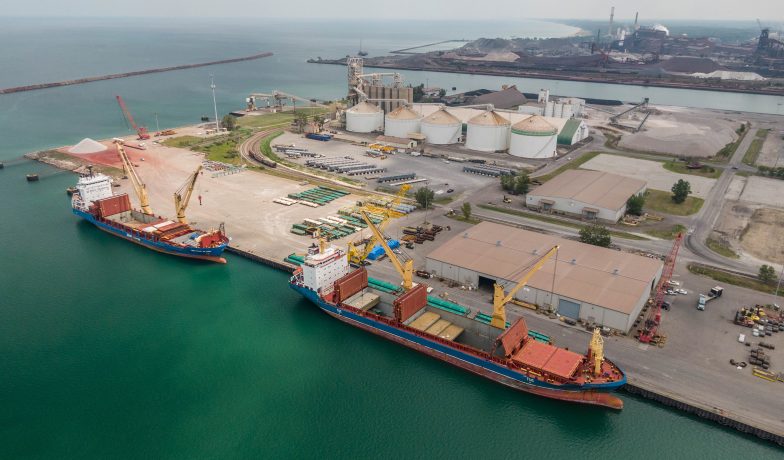
Feature image: Ports of Indiana-Burns Harbor/Photo courtesy of Ports of Indiana

Port of Cleveland, Milo Harbour Move Cross-Lake Truck Ferry Project Forward
The Port of Cleveland and Milo Harbour Inc. signed a memorandum of understanding (MOU) in July to initiate a new cross-lake truck ferry service between northeast Ohio and southern Ontario. ... Read More

Canada’s Retaliatory Tariffs on U.S. Goods Take Effect
Canada’s retaliatory tariffs of 15% to 50% on $27.6 billion worth of U.S. goods went into effect on Sept. 8. These new tariffs follow the collapse of bilateral trade negotiations with... Read More