

Advancing Agricultural Prosperity Among Great Lakes Shippers and Suppliers
The Michigan Soybean Committee (MSC) launched GLASS after more than two years of work to engage and bring together partners. GLASS met in Dearborn for its inaugural meeting in December 2024.
“We are currently boiling down the results of all our group discussions to make our 2026 group goals,” said Hanna Campbell, market development director of the Michigan Soybean Committee and a key event organizer. “Out of these goals, we will form working groups, while continuing the work of the 2025 groups. These groups are really where the best connections and relationships are built. While networking at the event itself is great, we see the most benefit from getting entities that may never work together otherwise into the same working group to bring many different perspectives towards overcoming a common problem.”
Investing in Biofuels
One of the largest problems facing vessel operators is marine emissions, and biofuels are a big part of any solution. “As an increasing number of vessel operators actively request and evaluate biodiesel blends as practical, locally sourced options to reduce carbon intensity and emissions today, fuel suppliers have taken note,” Campbell said. “The rising interest has led local suppliers, including Michigan Advanced Biofuels Coalition stakeholders Warner Petroleum Corporation and Al Warren Oil Company, to invest in equipment and infrastructure to market higher volumes of biodiesel (B100) and biodiesel blends in recent years.”
While fuel suppliers have limited influence over vessel operators’ day-to-day fuel choices, Campbell said the availability of renewable fuels plays an essential role in shaping adoption across the Great Lakes-St. Lawrence Seaway and beyond. Federal- and state-based incentives or requirements for fuel suppliers to increase the share of renewable fuels—combined with demand from vessel owners with corporate sustainability goals or voluntary commitments aligned with the International Maritime Organization (IMO) carbon-reduction targets—are the primary drivers behind recent demand growth. “There is a cost to decarbonization, and companies realize that although biodiesel blends may be more expensive than traditional marine fuels in some areas, it is still the most economical way to achieve sustainability goals, especially when compared to other fuels or technologies that require new engines and fueling infrastructure like methanol, hydrogen or ammonia,” Campbell said.
Interactive Map Under Development
One GLASS project under development is a second interactive map. “We are working to add a lot of information to our interactive maps. Our marine fueling location map will soon include many more fueling terminals,” Campbell said. “This map will list the location of where vessels can fuel up, fuel blends offered, including many servicing biodiesel blends, as well as capabilities of the location, service hours and more.”
Campbell said GLASS will send out a survey to all Great Lakes marine fuel providers during the winter season to have them update their fuel blend information for the upcoming spring and give new locations an opportunity to hop onto the map. “We are also working on adding information to our Great Lakes marine infrastructure map,” she added. “We currently have listings for many agricultural companies that offer marine services and shipping across the Great Lakes region.
Michigan currently has more infrastructure listed outside of agriculture as well as a goal for the map to include all active marine operations and existing opportunities for infrastructure. Campbell said both maps are still under construction, with more information being added over time.
Export Window
These conversations are happening at a time when climate change could be lengthening the export window and navigation season, increasing the scope of shipping—and the need for more emissions reduction. “Last shipping season, the St. Lawrence Seaway opened on March 22, 2025, with the 2025 navigation season closing on January 5, 2026,” Campbell said. “We have had conversations with exporters and ship lines about the possibility of the export window through the system expanding over time.
Campbell said the conversations show promise, especially due to the late closure dates being set in recent years. “We always circle back to the fact that the seasonal nature of the Great Lakes-St. Lawrence Seaway allows for a dedicated maintenance window. not only for lock and dam infrastructure, but also for the vessels themselves,” Campbell said.
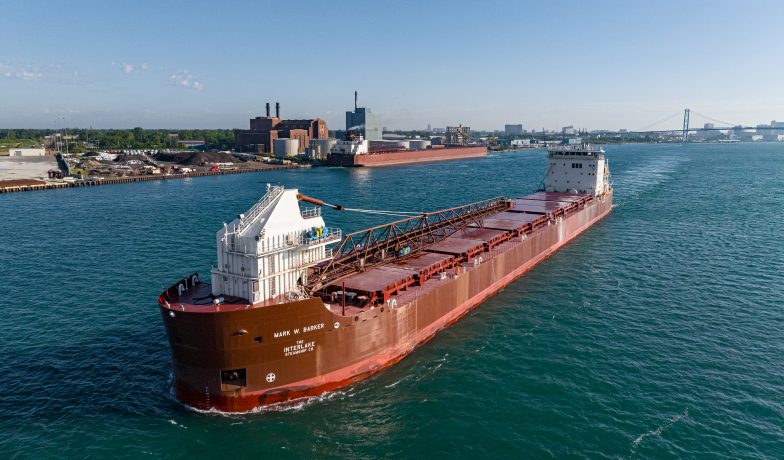
Feature photo: Mark W. Barker/Photo courtesy of the Michigan Advanced Biofuels Coalition

St. Lawrence Seaway Cargo Traffic Rises 3.5% Through September
Cargo traffic on the St. Lawrence Seaway increased 3.5% year over year through September 2026, reaching 24.941 million metric tons, according to year-to-date figures from the St. Lawrence Seaway Management... Read More
Port of Cleveland, Milo Harbour Move Cross-Lake Truck Ferry Project Forward
The Port of Cleveland and Milo Harbour Inc. signed a memorandum of understanding (MOU) in July to initiate a new cross-lake truck ferry service between northeast Ohio and southern Ontario. ... Read More