
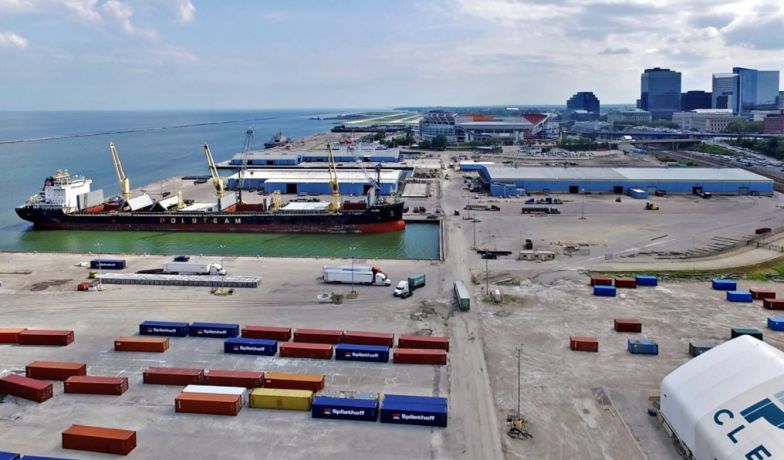

Port of Cleveland, Milo Harbour Move Cross-Lake Truck Ferry Project Forward
Expected to launch in early-to-mid 2028, the service will create a direct maritime cargo connection across Lake Erie, providing manufacturers, shippers, trucking companies and logistics partners with a reliable alternative to one of North America’s busiest and most congested border crossings while strengthening regional supply chain resilience and cross-border trade. The project is designed to improve supply-chain resilience by reducing dependence on increasingly congested highway and rail networks, particularly the Windsor-Detroit gateway, where approximately one-quarter of all Canada-U.S. merchandise trade crosses the border.
“The interest in this service has been exciting,” David Gutheil, chief operating officer of the Port of Cleveland, said. “This new service further solidifies the Port of Cleveland as a leader in providing innovative services within the Great Lakes maritime trade.”
The proposed Cross-Lake Truck Ferry Project would establish a cargo terminal at Milo Harbour in Wheatley, Ontario, connecting directly with the Port of Cleveland. The service is expected to accommodate up to 300 (round trip) truckloads per day, or 150 in each direction, while offering a new maritime transportation corridor for cargo moving between Canada and the United States. Milo Harbour Inc. is a Canadian maritime development company focused on advancing innovative freight transportation, port infrastructure and cross-border logistics solutions throughout the Great Lakes region.
Long History
Gutheil said the project has been envisioned in some form since 2011. It originally had passenger and car components, but those dropped out. “The security requirements and other things proved too difficult,” he said. The original Canadian partner was another lakeside community, Port Stanley.
Nevertheless, the demand for such a service has been constant. With an estimated one-way transit time of approximately two to three hours, the project provides a competitive alternative to current over-the-road truck transit times. Most of the port’s current truck traffic involves steel coils imported from Europe. The port’s biggest customer is the Cleveland Cliffs steel facility.
“This project represents a strategic opportunity for Wheatley, as well as the province of Ontario and all of Canada,” said Milo Harbour Project Director Kieran Stewart. “The team at Milo Harbour Inc. is committed to supporting Ontario and Canada’s plan to diversify trade and ensure our supply chains are stronger than ever. Along with our partners at the Port of Cleveland, we are becoming part of the solution to build Fortress North America.”
According to Gutheil, tariffs did not affect the project’s timeline. “We can’t wait until the tariff situation is resolved to start this project,” he said, adding that the service would probably operate on chartered vessels for the first couple of years to demonstrate its viability before a dedicated vessel is built.
Improved Access
Once cargo arrives in Cleveland, it will have immediate access to the port’s established highway and rail connections, reaching approximately half of the U.S. population within a 500-mile radius. According to Gutheil, the trucks will mostly be carrying local cargoes headed to destinations within a 250-mile radius of the port.
The project will also provide Canadian shippers access to the Port of Cleveland’s container service connecting to European markets. Conversely, Ohio– based exporters would have quicker and more efficient access to the Canadian marketplace.
For manufacturers on both sides of the border, the project comes as companies continue to invest in reshoring operations and diversifying supply chains across North America. At the same time, cargo networks face growing challenges, including driver shortages, increasing border congestion, and aging transportation infrastructure.
In addition to improving cargo mobility, the project is expected to reduce highway congestion and lessen wear on regional transportation infrastructure by shifting a portion of long-haul truck traffic onto the Great Lakes. Marine transportation lowers diesel emissions and improves air quality by reducing truck miles traveled.
The Port of Cleveland is leveraging funding from the U.S. Environmental Protection Agency’s Clean Ports Program to procure electric cargo-handling equipment, including cranes, forklifts and reach stackers, to reduce diesel emissions and advance cleaner, more sustainable port operations. The project developers are working with Canadian authorities on green grants.
The proposed corridor would leverage existing infrastructure at both ports, limiting the need for major new development. Gutheil said the project would require minor modifications to Dock 22 and Dock 24 North. Both the Port of Cleveland and Milo Harbour already offer industrial zoning, warehousing, cargo– handling equipment and space for cargo operations, helping reduce project costs and accelerate implementation.
Additional future investments would focus on customs and border-processing facilities, cargo terminal improvements, a roll-on/roll-off (Ro-Ro) ramp for trucks and trailers, and marine– handling infrastructure to support barge operations.

Port of Cleveland, Milo Harbour Move Cross-Lake Truck Ferry Project Forward
The Port of Cleveland and Milo Harbour Inc. signed a memorandum of understanding (MOU) in July to initiate a new cross-lake truck ferry service between northeast Ohio and southern Ontario. ... Read More

Canada’s Retaliatory Tariffs on U.S. Goods Take Effect
Canada’s retaliatory tariffs of 15% to 50% on $27.6 billion worth of U.S. goods went into effect on Sept. 8. These new tariffs follow the collapse of bilateral trade negotiations with... Read More