
Beyond Fuel Efficiency: Considering Embodied Carbon in Great Lakes Fleet Renewal
There have been some recent new investments in vessels on the Great Lakes. A few of these new projects include:
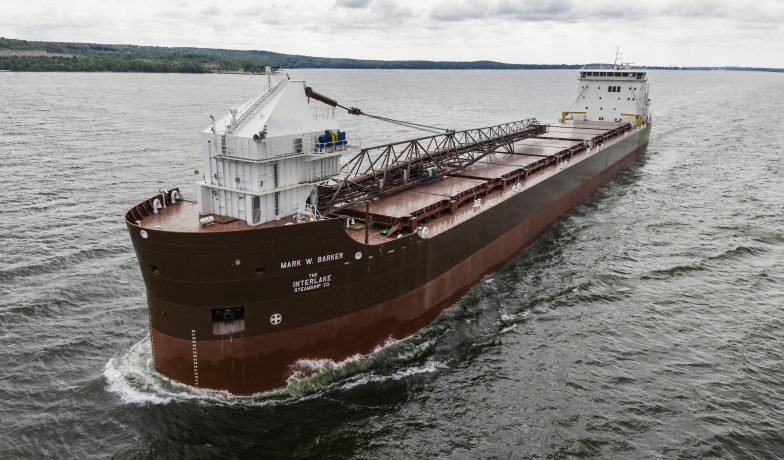
- The Mark W. Barker became the first U.S.-built Great Lakes bulk carrier in nearly 40 years, signaling renewed confidence in domestic shipbuilding while incorporating EPA Tier 4 engines and modern efficiency technologies.
- New vessels like the MV Tamarack, the first new cement carrier to enter Great Lakes service in two decades, are being designed with features such as diesel-electric propulsion, shore power capability, biofuel compatibility and energy-efficient cargo-handling systems.
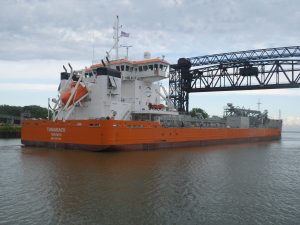
MV Tamarack
- Companies such as Fednav are committing to additional “super-eco” Lakers intended to replace older vessels while improving fuel efficiency and supporting the International Maritime Organization’s (IMO) long-term decarbonization goal.
At the same time, many existing vessels continue to undergo significant modernization. Engine repowering, ballast water treatment systems, emissions control technologies, hull improvements, digital navigation systems and cargo-handling upgrades are extending vessel service lives while improving environmental performance. Rather than replacing entire fleets, many operators are taking an incremental approach to decarbonization by investing in the vessels already in service.
These investments reflect a broader shift across the Great Lakes maritime sector, where sustainability is increasingly being considered alongside operational reliability, asset management, competitiveness and long-term business resilience.
The Question Not Being Asked
Sustainability is no longer just about reducing fuel consumption. It increasingly requires understanding the environmental impacts embedded within every stage of a vessel’s lifecycle, from steel production and construction to operation, maintenance and end-of-life. What if the vessel with the lowest emissions at sea is not necessarily the vessel with the lowest overall environmental impact?
Why This Matters on the Great Lakes
The Great Lakes are home to some of the longest-serving vessels in the world. Many of these were built to operate exclusively on the Great Lakes for their lifetime, unlike ocean-going vessels. Freshwater extends the lifetime of a vessel as it is less corrosive when compared to saltwater. Additionally, winter downtime provides an annual opportunity to undergo maintenance and upgrades during the offseason. As a result, many of these vessels in the Great Lakes system can operate for 50 to 70 years, with some extending beyond this.
Few places in the world operate commercial vessels for as long or rebuild them as extensively as the Great Lakes. This makes the conversation of retrofitting existing vessels or replacing them entirely an especially interesting discussion as the long service life seems to offer some benefit to reducing the lifetime carbon in a vessel.
The question becomes: how much of an environmental impact does shipbuilding have as compared to the operational emissions of the vessel over its lifetime?
What is Embodied Carbon?
Embodied carbon is a term used to describe the greenhouse gas (GHG) emissions generated during the design, production, transportation and construction of a vessel before it enters service. This includes emissions from steel production, engine and equipment manufacturing, fabrication, assembly, coatings and the transportation of materials and components before the vessel ever moves its own cargo.
While embodied carbon is a common variable in infrastructure, the maritime industry is only beginning to add in this consideration to decision-making. Most vessel investment decisions already consider lifecycle cost: balancing capital investment, operating expenses, maintenance and expected service life. Lifecycle carbon (another term for embodied carbon) applies the same principle to greenhouse gas emissions, considering not only those produced while a vessel is operating, but also emissions generated from building it in the first place. This broader perspective provides a more complete understanding of a vessel’s true environmental footprint and can help inform decisions around retrofitting existing vessels or investing in new construction.
Retrofit Versus Replacement
There is no single pathway to reducing emissions from the Great Lakes fleet. In some cases, modernizing an existing vessel may deliver substantial environmental benefits. In others, replacement may provide the greatest long-term value. The challenge is determining which approach results in the lowest overall lifecycle emissions.
Retrofitting an existing vessel can improve operational efficiency while extending the useful life of the asset. Depending on the vessel and its intended service, upgrades may include engine repowers, hybrid propulsion systems, shore power compatibility, battery-assisted operations, waste heat recovery, advanced hull coatings, digital voyage optimization, propeller modifications or other efficiency improvements. Many of these technologies reduce fuel consumption and greenhouse gas emissions without requiring an entirely new vessel to be constructed.
New vessel construction, however, also presents important opportunities. These can be designed from the outset with an optimized hull form, highly efficient propulsion systems, compatibility with alternative fuels, improved cargo-handling and lower maintenance requirements. These designs may achieve operational efficiencies that are difficult to obtain through retrofit alone.
The key question is not simply which vessel burns less fuel, but whether those operational savings are sufficient to offset the emissions associated with constructing a new vessel. This is often referred to as the carbon payback period, or the time required for emissions saved on the operations side to exceed the embodied carbon generated in the building of the replacement vessel.
The answer will differ for every project. A replacement vessel offering substantial efficiency gains may offset its embodied carbon within a relatively short period, while more modest improvements could require decades to achieve the same result. In some cases, particularly where an existing vessel can be easily modernized, the embodied emissions associated with new construction may not be fully recovered through operational savings alone.
Ultimately, the decision to retrofit or replace should not be based on age or fuel efficiency alone. Instead, it should consider the vessel’s remaining service life, operational requirements, maintenance needs, future fuel options, end of life recyclability and both embodied and operational greenhouse gas emissions. A lifecycle perspective provides the most complete picture of a vessel’s true environmental performance over its lifetime.
Looking Through a Lifecycle Lens
When looking at the lifetime GHG emissions associated with a vessel, the answer to always retrofit or always replace becomes a gray area. Instead, a lifecycle assessment should be considered for each case to get a comprehensive understanding of the embodied emissions of a new build as compared to the operational savings of a modernized vessel.
Considerations include operational emissions, embodied carbon, remaining life, maintenance costs and alternative fuel compatibility. This enables investments that reduce total lifecycle emissions rather than simply shifting where those emissions occur.
For decades, Great Lakes operators have kept vessels in service through careful maintenance, repowering, structural repairs and modernization because it made operational and economic sense. The industry has been practicing an important form of sustainability for years through good asset management; it just hasn’t been measured through the lens of embodied carbon.
As the Great Lakes fleet continues its transition toward lower-carbon operations, the most sustainable vessel may not always be the newest one. By considering both operational and embodied emissions, owners can make decisions that deliver genuine environmental benefits while preserving the resilience and economic strength of one of North America’s most unique shipping systems.
Feature photo: Mark W. Barker
Emily Alexander is a senior associate scientist at Tunley Environmental. She can be reached at EmilyAlexander@tunley-environmental.com.

Beyond Fuel Efficiency: Considering Embodied Carbon in Great Lakes Fleet Renewal
For decades, new vessel construction was a rarity on the Great Lakes. Recent years have seen renewed investment in vessel construction that prioritizes modern environmental and operational outcomes. The modernization... Read More
CSL Leads in Sustainable Marine Solutions
The CSL Group is investing in decarbonization efforts and hiring more women as part of its goal to set positive trends for the entire Great Lakes shipping industry. Based in... Read More