
AGLPA Study Identifies Opportunities to Expand Trade Between the Great Lakes and Inland Waterways
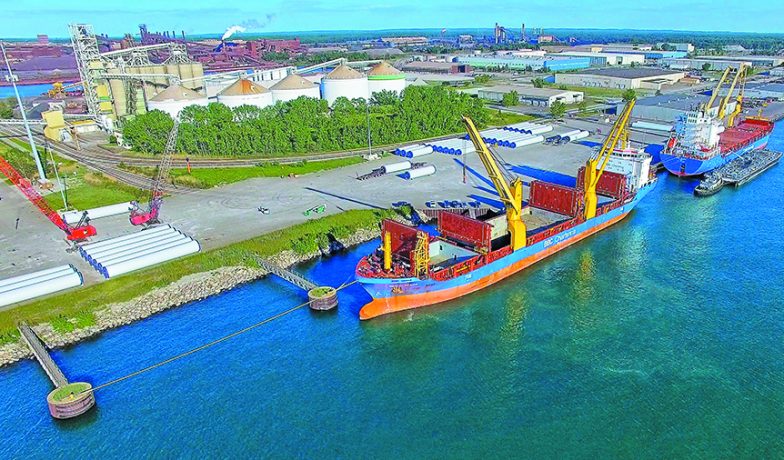
The American Great Lakes Ports Association (AGLPA), in partnership with the Great Lakes St. Lawrence Seaway Development Corporation (GLS), Ports of Indiana, the Illinois International Port District (IIPD) and Port Milwaukee, released The Great Freight Connection, a study conducted by transportation consulting firm CPCS Transcom Inc.
The research examines how increased cargo movement between the two systems could make better use of existing maritime infrastructure. In 2023, approximately 138 million tons of cargo moved on the Illinois Waterway and Great Lakes, yet only a small amount of freight moved between the systems. About 5% of outbound Illinois Waterway tonnage went to the Great Lakes, while less than 1% of outbound Great Lakes tonnage moved to the Illinois Waterway.
The study identifies commodities and trade routes where water transportation could offer a cost-effective alternative to existing shipping methods. It focuses on four potential trade lanes, all of which use the T.J. O’Brien Lock to connect the Great Lakes with the Illinois Waterway.
Four Potential Trade Routes
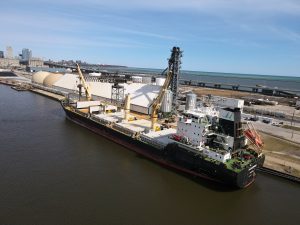
The first route examines moving grain and other agricultural products southbound from Port Milwaukee in Wisconsin to the Gulf. Based on the study’s analysis, barge transportation could save an estimated $4.50 per ton compared with rail. Although the all-water route is estimated to produce about 5% more carbon emissions than the rail alternative, it could provide shippers with another option when low water levels affect the Upper Mississippi River or rail congestion limits access through Chicago, Illinois.
The second route proposes moving steel products from Ports of Indiana-Burns Harbor to Peoria, Illinois, and St. Louis, Missouri. Shipping by water could save approximately $20.70 per ton to Peoria and $34.40 per ton to St. Louis compared with trucking. At 100,000 tons, the Peoria route could eliminate approximately 5,100 truck trips and reduce carbon emissions by about 2,300 metric tons. The St. Louis route could eliminate approximately 3,800 metric tons of emissions. The study estimates that the all-water route produces about 87% fewer emissions per ton than trucking.
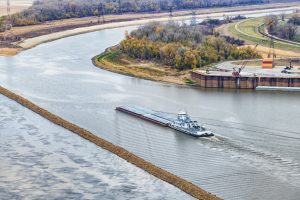
The third route evaluates northbound liquid bulk shipments, including petroleum products, from the Joliet and Lemont area of Illinois to Port Milwaukee. The estimated savings are approximately $1.80 per ton compared with rail. At 100,000 tons, the route could represent about 1,000 rail cars and approximately $178,000 in transportation savings. The study estimates emissions would increase by about 6% compared with rail, but notes that the route could diversify supply chains and offer safety advantages for hazardous-material transportation. The movement would require tank barges capable of operating on the Great Lakes.
The fourth route examines moving road salt northbound from the Gulf to IIPD. The analysis estimates potential savings of approximately $19.10 per ton compared with rail. At 100,000 tons, that volume would represent roughly 1,000 rail cars. Emissions are estimated to increase by about 1.7%, but the seasonal nature of road salt demand could make the longer barge transit practical through advance shipments and stockpiling.
Challenges and Opportunities
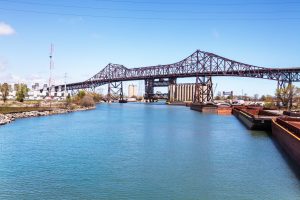
Despite the economic benefits, there are challenges that can impact expanding cross-system shipping. Infrastructure constraints include bridge clearances, aging locks and the need to maintain navigable depths. The study cites the BNSF bridge on the Chicago Sanitary and Ship Canal as a particular challenge for larger vessels. Water-level fluctuations, drought, flooding, ice and lock closures can also affect reliability and scheduling.
Expanded trade will also require equipment capable of operating on both the inland waterways and Great Lakes, including lake-capable barges and specialized vessels for certain commodities. The study also references increasing pressure on industrial waterfront property, which could limit the availability of land for future terminals, manufacturing and distribution.
The report outlines 15 recommendations organized around market development and partnerships, priority industries and commodities, policy and regulatory coordination and strategic infrastructure improvements.
Recommendations include engaging shippers directly to better understand their transportation needs, improving information about terminal facilities and capabilities, developing a directory of terminal operators and promoting the waterways as an alternative during supply chain disruptions. The study also encourages communication with manufacturing, steel, agricultural and energy industries to identify commodities suited to cross-system transportation.
Infrastructure recommendations include supporting the development of lake-capable barge fleets, coordinating with the U.S. Army Corps of Engineers (Corps) to maintain navigable depths on the Illinois Waterway, expanding support services for vessels and containers and exploring options to increase rail bridge clearance.
The study emphasizes that expanding freight movement will require more than physical connections. Greater awareness among shippers, stronger partnerships between ports and terminal operators, and a clear business case for moving specific commodities by water will be necessary.
The projected freight volumes and savings are not guaranteed outcomes. The analysis evaluates annual diversion levels of 25,000, 50,000 and 100,000 tons, but no shipper volumes are committed. Cost estimates are based on industry averages rather than contract-specific rates, and transloading, handling and storage costs are not fully quantified. Actual costs and benefits will vary by shipper, commodity and route.
AGLPA and its partners plan to use the findings to continue discussions with shippers, carriers, terminal operators and other stakeholders about opportunities to expand cargo movement between the Great Lakes and inland waterways.

AGLPA Study Identifies Opportunities to Expand Trade Between the Great Lakes and Inland Waterways
A new study identifies opportunities to expand cargo movement between the Great Lakes and the United States’ inland waterways, potentially lowering transportation costs, providing shippers with additional freight options and strengthening... Read More

Closing of the 2026 Navigation Season
The St. Lawrence Seaway Management Corporation (SLSMC) has announced closing dates for the 2026 navigation season, with different deadlines established for the Montreal-Lake Ontario Section, Welland Canal and Sault Ste.... Read More