
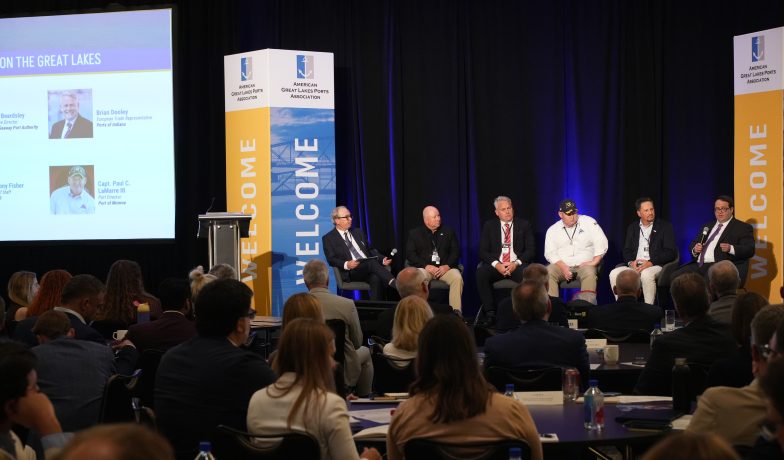

Great Lakes Stakeholders Discuss Reliability and Cargo Expansion at Annual AGLPA Conference
The 2026 conference kicked off with AGLPA Executive Director Brian Oszakiewski and Capt. Paul C. LaMarre III, president of the AGLPA, highlighting the economic value the Great Lakes-St. Lawrence Seaway contributes to the maritime industry.
Speakers covered a variety of topics and issues impacting trade along the Great Lakes-St. Lawrence Seaway and specifically called for greater cooperation, infrastructure investment and cargo diversification as they seek to increase use of the binational waterway. Mike McCoshen, administrator of the Great Lakes St. Lawrence Seaway Development
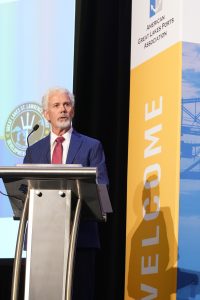
Corporation (GLS) spoke about the importance of collaboration and partnership between the United States and Canada. “The partnership between the GLS and SLSMC is one of the keys to maintaining stability, reliability and operational excellence throughout the Seaway,” McCoshen said. “We share resources, technologies, best practices and operational strategies. We coordinate continuously to maintain high standards of safety, efficiency and most importantly for our customers, predictability. In today’s global economy, predictability is a competitive advantage.”
McCoshen said the system also needs to adapt to changing trade patterns and customer demands. Opportunities include project cargo, breakbulk, energy-related cargo, manufacturing inputs and other specialized freight, in addition to the traditional bulk commodities that move through Great Lakes ports.
Container Capabilities
Containerization is one area that draws particular attention. Four U.S. Great Lakes ports are actively involved in developing container capabilities, but there currently are no regularly scheduled short-sea container services connecting those ports. Peter Hirthe, director of the office of trade and economic development at the GLS, led a panel discussion focusing on the future of containerization on the Great Lakes. Kevin Beardsley, executive director of the Duluth Seaway Port Authority, said the port has handled containers since completing a maritime container facility in 2022, primarily for project cargo and other sporadic business. The port also receives a monthly service from Antwerp, Belgium.
The Port of Monroe, Michigan, is nearing completion of a $19.5 million container facility that will support Customs and Border Protection operations. LaMarre, Monroe’s port director, said the facility was 97% complete and expected to receive a certificate of occupancy for customs within weeks of the conference.
Jeff Epstein, president and CEO of the Port of Cleveland, said the facility has handled containers for 12 years and has the infrastructure and customs capabilities to continue doing so. But the port has struggled to establish a financially sustainable service. It has handled about 35,000 TEUs over that period, with volumes peaking at 10,000 TEUs in 2022 and falling below 350 TEUs last year. Epstein said the operation has lost about $11 million over the 12-year period.
Brian Dooley, European trade representative for Ports of Indiana, said he is working with Customs and Border Protection on the requirements needed to establish container capabilities and is also talking with ocean carriers, freight forwarders and potential cargo owners about a possible service.
Building Consistency
The discussion reflects a broader question facing the Seaway: how to increase cargo volumes while making the entire transportation route simpler and more competitive for shippers.
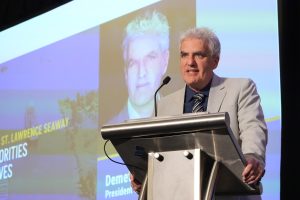
Jim Athanasiou, president and CEO of the St. Lawrence Seaway Management Corporation (SLSMC) said the Seaway currently operates at about 50% of its potential capacity. He said shippers evaluate the entire transportation journey, including cost, reliability, handoffs and complexity, rather than the performance of an individual port or portion of the waterway.
“Cargo likes consistency, certainty and competitiveness,” Athanasiou said. “It does not like costs and complexity.”
That systemwide approach also applies to infrastructure and technology investments. Athanasiou said modernization should be focused on delivering value to customers, including making the movement of cargo easier and more predictable.
The need for coordination was also emphasized by Stephen Carmel, administrator for the U.S. Maritime Administration (MarAd). Carmel said the federal government is increasingly viewing maritime transportation as a system that supports manufacturing, agriculture, energy, defense and trade rather than a collection of separate sectors.

For the Great Lakes, Carmel said that broader maritime strategy should include the region.
Tony Fisher, chief of staff at MarAd, proposed developing a feeder service that would connect Great Lakes ports with larger Canadian, European or East Coast ports. Rather than attempting to operate large container ships directly across the Atlantic, smaller vessels could move containers between the Great Lakes and established international services.
Fisher said such a model could address several of the barriers that have limited containerization on the Seaway, including vessel size, service frequency and customs costs.
He also suggested examining whether containers could be cleared and scanned at a central location before entering the Seaway, rather than requiring individual Great Lakes ports to make major investments in scanning facilities. The approach, he said, could reduce costs for ports handling relatively small container volumes.
Ports participating in the containerization discussion said a successful service would require cooperation among ports, railroads, ocean carriers, freight forwarders and cargo owners.
Dooley said Ports of Indiana is pursuing discussions with feeder operators and deep-sea carriers while also seeking information from major Midwest importers. The goal is to determine whether enough cargo exists to support a viable service.
System Challenges
Seasonality remains another consideration. A Great Lakes container service would need to account for the Seaway’s winter closure, potentially requiring ports and shippers to use storage and rail connections during the off-season.
The officials also pointed to resilience as a potential benefit of expanding Great Lakes cargo options. A more diversified network could provide alternatives when disruptions affect coastal ports or other transportation corridors.
The Seaway’s winter operating conditions were a recent example of the need for resilience. Athanasiou noted that an early onset of winter at the end of the previous season left vessels in the system and required operations to continue into January to clear them.
McCoshen said investments in lock infrastructure, hands-free mooring, asset modernization and operational improvements have strengthened the system’s resilience. He also emphasized the importance of workforce development, noting the need for mariners, engineers, logistics specialists, port operators and other maritime professionals.
Other conference discussions centered on policy partnerships, regional strategies, infrastructure updates from the U.S. Army Corps of Engineers and innovation advancements on the Great Lakes-St. Lawrence Seaway system.
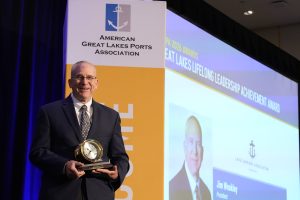
In addition, the AGLPA presented James H.I. Weakley, president of the Lake Carriers’ Association, with the Great Lakes Lifelong Leadership Achievement Award. Mark Schrupp, executive director of the Detroit/Wayne County Port Authority, was the recipient of the Maritime Leadership and Public Policy Achievement Award.
The 2027 AGLPA conference has been scheduled for July 29-30, 2027, at the Loews Chicago Hotel.
Photos courtesy of AGLPA/Nick Robins Photography

St. Lawrence Seaway Cargo Traffic Rises 3.5% Through September
Cargo traffic on the St. Lawrence Seaway increased 3.5% year over year through September 2026, reaching 24.941 million metric tons, according to year-to-date figures from the St. Lawrence Seaway Management... Read More
Port of Cleveland, Milo Harbour Move Cross-Lake Truck Ferry Project Forward
The Port of Cleveland and Milo Harbour Inc. signed a memorandum of understanding (MOU) in July to initiate a new cross-lake truck ferry service between northeast Ohio and southern Ontario. ... Read More