
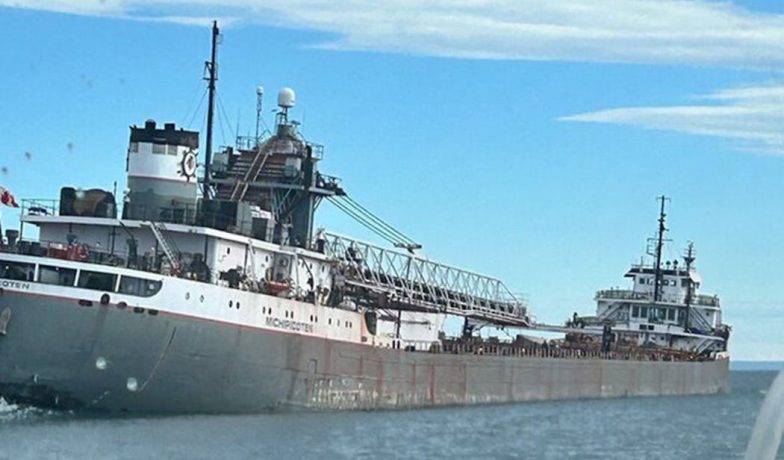

Large Crack Discovered in Hull of Great Lakes Freighter
It was first believed the Michipicoten, which was carrying taconite mined on Minnesota’s Iron Range, collided with something underwater. On Monday evening, the USCG reported a 13-foot crack was found in the ship’s hull. The crack caused a ballast tank to flood, as well as the “centerline void,” which is an empty space between the hatch floor and the hull.
A spokesperson with the Transportation Safety Board of Canada stated the crack resulted from fatigue or structural failure. U.S. and Canadian officials continue to investigate the cause.
The vessel is at Keefer Terminal in Thunder Bay, where temporary patches are being installed to make it seaworthy. The Michipicoten is then expected to sail under its own power to another port where more repairs will be made.
The Michipicoten is a self-discharging lake freighter that entered service in 1952 under the name Elton Hoyt II. The vessel is owned and operated by Canadian shipping firm Lower Lakes Towing, a subsidiary of Rand Logistics. The Michipicoten primarily hauls taconite from Marquette, Michigan, to the Algoma Steel Mill in Sault Ste. Marie, Ontario.

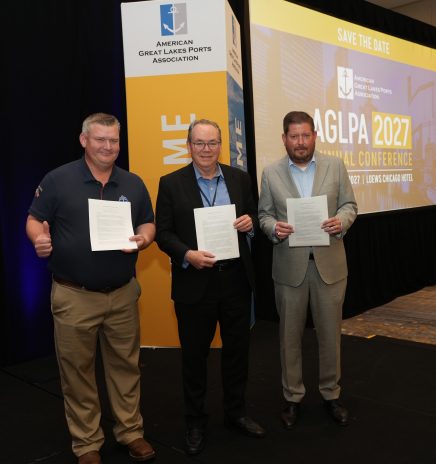
Building Partnerships Between Great Lakes Ports and Shipyards
The American Great Lakes Ports Association (AGLPA) and Great Lakes Alliance of Shipyards have signed a memorandum of understanding establishing a formal partnership between the region’s port and shipyard communities. ... Read More

Fraser Industries, HD Hyundai Outline Plan to Modernize U.S. Shipyard Operations
Fraser Industries LLC has signed a memorandum of understanding (MOU) with HD Korea Shipbuilding & Offshore Engineering (HD KSOE) to collaborate on modernizing U.S. shipyards, with Fraser Shipyards in Superior, Wisconsin, expected... Read More