

One Seaway System, Two Flags and a Lot of Unfinished Coordination
Everyone who works on the Seaway understands this reality. Yet when it comes to shipbuilding, icebreaking and long-term infrastructure investment, planning is still largely conducted along national lines.At the same time, the Great Lakes fleet is entering its first meaningful renewal cycle in decades, under operating conditions that are increasingly unstable. Warmer winters are reducing ice cover and increasing evaporation, while more intense and less predictable precipitation is driving rapid swings between record low and record high water levels. These shifts are eroding decades-old planning assumptions and reinforcing a simple engineering truth: optimizing performance on the Great Lakes cannot be achieved by one country acting alone.
A Single Engineering System
From an engineering standpoint, the Great Lakes and the connecting channels function as a single operating environment. Vessel designs are governed by the same lock dimensions, channel depths, bridge clearances and seasonal constraints, regardless of which flag the vessel flies. Delays or capacity limitations in one part of the system ripple outward, affecting terminals, cargo schedules and vessel availability across both countries.
Despite this interdependence, capital investment and technical planning often remain fragmented. Shipbuilding incentives, icebreaking strategies, fleet renewal programs and port upgrades are typically aligned with national or local priorities rather than system-wide performance objectives. While regulatory and operational coordination exists through national Seaway authorities and other binational agencies, deeper technical alignment, particularly around long-range planning and capital investment, remains inconsistent.
The result is not just inefficiency. It is engineering risk.
When system-level assumptions diverge, vessels and infrastructure rarely perform as intended. Designs optimized for one set of expectations can quickly become constrained by realities elsewhere in the system.
Icebreaking: The System’s Governing Constraint
Nowhere is this disconnect more visible than icebreaking.
Ice management on the Great Lakes is not a localized service; it is a system-level constraint. Whether a vessel can move in January depends not only on its own design, but on the availability, capacity and coordination of icebreaking assets across multiple critical waterways.
The United States and Canada operate separate icebreaking fleets with different procurement cycles, construction and maintenance strategies, operating budgets and mission priorities. From an engineering and operational perspective, these differences introduce uncertainty. New vessels may be designed with extended-season capabilities, but without aligned system-level icebreaking support, those capabilities often go unused.
That is not a vessel design problem. It is a system design problem.
If winter navigation is expected to be reliable and predictable, icebreaking must be treated as shared infrastructure, no different than locks or channels, rather than as a collection of nationally managed assets.
Shipbuilding Assumptions Must Match System Reality
Discussions about Great Lakes shipbuilding readiness often focus on national capacity. Can U.S. shipyards deliver new vessels on schedule and at competitive cost? Are Canadian yards prepared to support fleet renewal? Will governments sustain the icebreaking capacity required to expand the navigation season?
These are all important questions, but they overlook a more fundamental one: are vessels being designed around a shared, system-level understanding of how the Seaway operates?
Engineering assumptions about ice severity, system capacity, traffic congestion, lock reliability and infrastructure availability shape everything from hull form to propulsion selection. When those assumptions differ between countries, or between agencies operating within the same system, vessels can end up optimized for one part of the Seaway and constrained by another.
Early binational alignment during concept development and preliminary design would significantly reduce uncertainty for owners, designers and shipyards, while improving lifecycle performance and avoiding costly compromises later.
Infrastructure Does Not End at the Border
Locks, channels, ports and navigation aids do not function as standalone assets; they operate as a continuous chain. A maintenance delay, capacity shortfall or modernization gap at one location affects system performance everywhere else.
From a systems engineering perspective, the Great Lakes–St. Lawrence Seaway should be evaluated against shared performance objectives: reliability, safety, season length and environmental compliance. Achieving those objectives depends on aligned planning horizons, consistent technical data and shared operating assumptions, complementing existing policy coordination with deeper engineering collaboration.
Coordination as Risk Reduction, Not Bureaucracy
This is not a call for more bureaucracy. It is a call for engineering realism.
Practical steps toward deeper coordination could include shared technical working groups, aligned ice-performance metrics, joint scenario planning for extreme weather and low-water events and binational data frameworks to support vessel design and operational modeling.
None of this requires reinventing the Seaway System. It requires treating it as what it already is.
The payoff is greater predictability for shipowners, designers, shipyards and regulators—and more resilient engineering outcomes across the system.
One System, One Engineering Challenge
The Great Lakes–St. Lawrence Seaway is a rare and valuable binational marine corridor competing on a global stage. The system’s future will not be shaped solely by how much is invested, but by how well technical decisions are aligned on both sides of the border.
Shipbuilding, icebreaking and infrastructure planning cannot be solved independently because the Great Lakes themselves are not independent. Engineering a stronger, more resilient Great Lakes future begins with a shared set of assumptions, shared data and shared technical conversations; before steel is cut and before capital decisions are locked in.
The system already operates as one. Our engineering approach should be done the same.
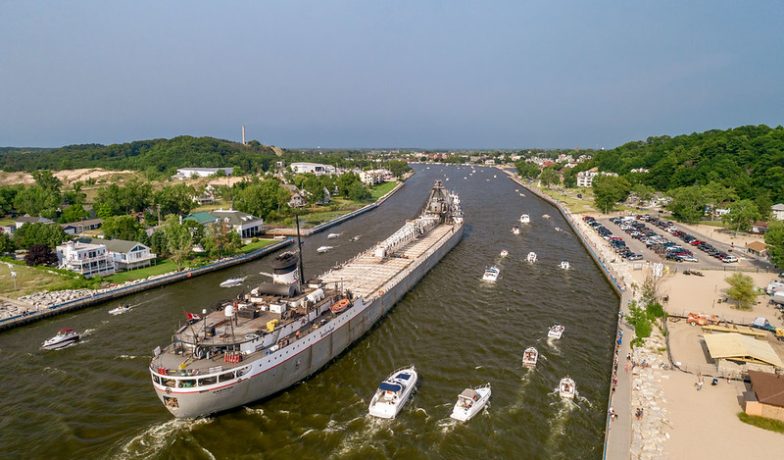
Feature photo: Saginaw/Photo courtesy of Lower Lakes Towing

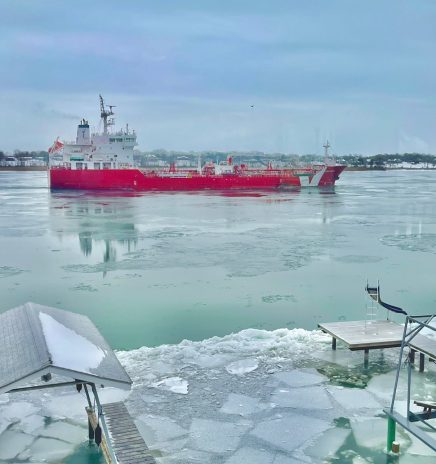
Engineering the Great Lakes-St. Lawrence Seaway System in a Climate of Contradictions
The traditional way that naval architects and marine engineers design vessels and systems, particularly in a captive environment like the Great Lakes, is often to rely on the past performance of actual operating vessels. Marine engineers, supported by both owners... Read More
One Seaway System, Two Flags and a Lot of Unfinished Coordination
The Great Lakes–St. Lawrence Seaway system doesn’t care much about political borders. Ice doesn’t stop at the 49th parallel. Water levels don’t adjust to national budgets. A vessel delayed in Canadian waters still misses its berth in the United States, and an... Read More