

The Critical Need for Another Great Lakes Icebreaker
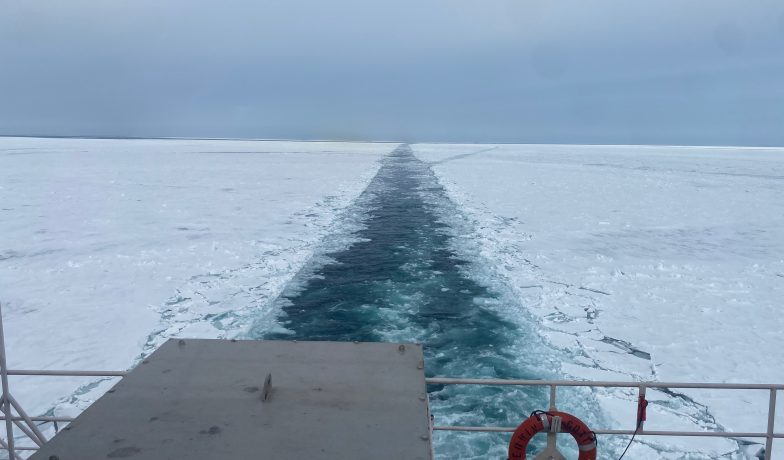
For Great Lakes shipping, icebreaker capabilities and readiness were particularly critical because of this winter’s severe conditions. Consider that the Soo Locks, in Sault Ste. Marie, Michigan, were scheduled to open on March 25. According to the Lake Carriers’ Association (LCA), it took 96 hours after the Soo Locks opened for the first vessel loaded with iron ore to clear the St. Marys River. At one point, 19 vessels were stopped for multiple days in the lower St. Marys River and Whitefish Bay, waiting for icebreakers to assist. The only U.S. Coast Guard (USCG) heavy icebreaker on the Great Lakes, the Mackinaw, was limited to operating below the Soo Locks due to an engineering casualty. The ice in Whitefish Bay was 2 feet thick and covered with 3 feet of snow. A Canadian icebreaker was deployed to help but was then diverted en route for another mission. The 140-foot USCG icebreaking tugs, which are nearly 50 years old, often break down and are unable to assist with opening the navigation routes.
According to the LCA, U.S.-flagged shipping on the Great Lakes lost 1,953 hours, or 82 days, due to inadequate icebreaking. The 2026 deep freeze once again raised the issue of why a commitment to expand the icebreaker fleet on the Great Lakes hasn’t occurred. There have been numerous initiatives advanced to support America’s maritime system. The ICE Pact icebreaker agreement between the United States, Canada and Finland is a prime example and focused on icebreakers. The Maritime Action Plan seeks to rebuild and reinvest in American maritime capacity, both for operations and infrastructure. The Department of Homeland Security (DHS) classifies the Great Lakes system as a “Tier One” waterway, making it a high priority due to geographical location or importance of cargo to public health.
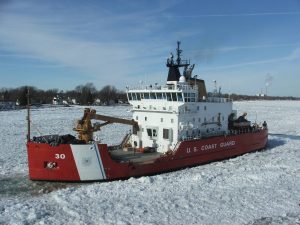
In recent years, during numerous Congressional hearings, members of Congress on both sides of the aisle have pressed DHS and the USCG with the same question: when will commitments to new Great Lakes icebreakers be included in their new vessel planning and related budgets?
Answers are overdue. The National Defense Authorization Act for Fiscal Year 2026 was enacted on December 18, 2025. In Section 7215 “Great Lakes Icebreaking,” it directs the commandant of the USCG to present to House and Senate committees a detailed strategy within 90 days regarding how the USCG “will complete design and construction of a Great Lakes icebreaker at least as capable as the Coast Guard cutter Mackinaw.” The report is to include a cost estimate and an estimated delivery timeline “that would facilitate the expedited delivery detailed in the strategy.”
The 90-day deadline was March 18. A strategy document was not delivered to the committees. A spokesperson for the House Committee on Transportation and Infrastructure said the strategy added that the USCG is using previously appropriated money to conduct design work on a Great Lakes icebreaker based closely on the Mackinaw. The committee is encouraging the USCG to use this current work as the basis of a future construction appropriation request. The spokesperson also pointed out that in the first version of last year’s reconciliation bill, the House included $5 billion for domestic icebreakers, including one that was at least as capable as the Mackinaw. However, that funding was removed in negotiations with the Senate on the final reconciliation package.
Credit for the icebreaker directives and deadlines and strategy goes to Rep. Kristen McDonald Rivet (MI-08), who, last July, introduced stand-alone legislation titled the Great Lakes Icebreaker Act of 2025 (HR 4375). That bill did not advance on its own, but the text of McDonald Rivet’s bill was subsequently added to the larger Defense Authorization Act.
When asked about the March 18 deadline, McDonald Rivet’s press team said they are working with the USCG to check on follow-up, to ensure that the act’s requirements are met. In response to questions, McDonald Rivet noted that “thousands of Michigan jobs and billions of dollars in economic activity depend on our ships’ ability to move throughout the Great Lakes. Delays can be disastrous, disrupting good-paying jobs and livelihoods. We need more icebreakers to keep shipping lanes open during Michigan winters.” She added that “The president signed my legislation into law to get new, stronger icebreakers on the Great Lakes. Our shipping industry needs Washington to get moving so we can avoid the kinds of setbacks we saw this winter.”
In addition to a strategy, the authorization act sets other requirements. On June 18, a second report is due on the USCG’s plans regarding replacement of the Bay-class icebreaking tug fleet. If replacement isn’t feasible, then a maintenance plan is due and, more specifically, if the tugs’ engines and gear components are not replaced, the USCG must report on how that old equipment will affect the fleet’s operational availability.
Another requirement is that the USCG must start a five-year pilot program to determine if the Great Lakes icebreaker fleet can keep Tier One and Tier Two waterways open 95% of the time. That work also requires a follow-up report that must update a 2024 report by the General Accountability Office regarding icebreaker performance measures. In the winter, the goal for DHS and the USCG is to ensure that Tier One shipping lanes in the Great Lakes and along the eastern seaboard remain open 95% of the time during ice season. For FYs ’24 and ’25, those routes were open 99.9% of the time. The number for FY ’26 isn’t available yet.
Another report is due next December on the Mackinaw. This report must describe:
- The Mackinaw’s midlife maintenance availability assessment
- The hull’s remaining service life
- Cost and operational impacts if the vessel undergoes a “Service Life Extension Program” to refurbish, upgrade or modernize the vessel to extend usability beyond its original design life
Beyond the Great Lakes
Even though an icebreaker for the Great Lakes isn’t on the horizon, icebreakers are in the spotlight for venues beyond the region.
At the end of March, the USCG issued a “request for information” (RFI) announcing that it was “conducting market research” to support a potential future acquisition of up to seven Homeland Security Cutter – Light Icebreakers, the type that can be used on the Great Lakes. If the USCG decides to move forward with this RFI process, it could advance quickly, possibly awarding a contract later this year.
In April, the Maritime Administration (MARAD) released an RFI pertaining to icebreakers. It remains open for comments until June 5. MARAD seeks information about U.S. shipyards that have the capacity to build icebreakers, information that will be used to advance ICE Pact agreements, both regarding vessels and vessel construction.
For President Donald Trump and his administration, polar icebreakers are a high priority item. The president signed an authorization for four cutters last October. The authorization noted there are just two arctic cutters now – one commissioned in 1976 and the other a reconfigured commercial vessel – renamed Storis – being recast as an icebreaker. In December, the USCG announced two contracts to build up to six Arctic Security Cutters. MARAD seeks replies to a series of questions covering workforce, technology and infrastructure, all critical for advancing to more efficient icebreaker construction. In February, the USCG announced additional cutter contracts, bringing the total number to 11 Arctic Security Cutters.
Budgets and Spending
The president’s FY 2027 budget was released on April 3. The Budget Overview document prepared for DHS and the USCG explains that the primary PPA, or “program, project or activity,” for Fiscal Year 2027 continues to be the modernization of the USCG surface fleet, with budgeting for the following spending priorities:
- Acquisition of up to 30 Waterways Commerce Cutters (WCCs)
- Starting stage 3 of the Offshore Patrol Cutter (OPC) program
- Advancing the Commercially Available Polar Icebreaker (CAPI) toward full operational capability. This includes finishing the work on the Storis, acquired in 2024, to turn that vessel into an icebreaker.
- Providing for the service life extension and major maintenance of existing legacy cutters
- Procuring boats to support cutter and shore operations
Great Lakes and icebreakers, at least regarding money and a new vessel, are not mentioned in the president’s FY 27 budget docs. The only new icebreaker money is $25 million to complete work on the Storis.
The president’s budget is just the start of the federal budget process, presenting the administration’s priorities. Congress makes final decisions about what to include in each year’s federal budget. It’s a process that is supposed to be completed by September 30.
Feature photo courtesy of Lake Carriers’ Association

The Critical Need for Another Great Lakes Icebreaker
Icebreakers are complex vessels — almost as complex as the politics required to construct them. For Great Lakes shipping, icebreaker capabilities and readiness were particularly critical because of this winter’s severe conditions. Consider that the... Read More
Ice Conditions Renew Calls for Additional U.S. Icebreaker on Great Lakes
Commercial shipping on the Great Lakes has slowed sharply just a few days into the 2026 navigation season, as ice conditions in the St. Marys River and Whitefish Bay halted vessel traffic and renewed... Read More